Welcome to the Mathematical World!
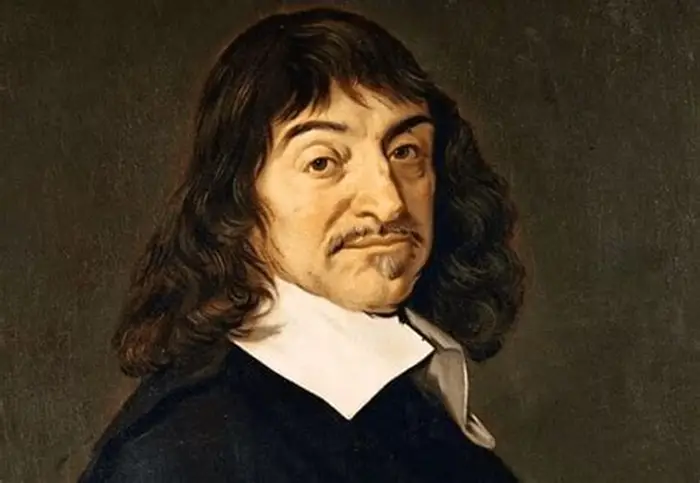
René Descartes (1596 – 1650)
Founder of Analytic Geometry and the Cartesian Plane
Descartes merged algebra and geometry, inventing analytic geometry and the Cartesian plane. His symbolic notation gave algebra lasting clarity, while his vision of mathematics as a universal method influenced both science and philosophy. He made equations a tool for describing reality, from curves to motion.
One of his most important contributions was the introduction of a coordinate system where a point in the plane is represented by an ordered pair \((x, y)\). This allowed algebraic equations to represent geometric objects: for example, the equation \[ x^2 + y^2 = r^2 \] describes a circle of radius \(r\), while \[ y = mx + c \] represents a straight line. Such formulations bridged the gap between abstract algebra and tangible geometry.
Beyond mathematics, Descartes’ philosophy of systematic doubt encouraged rigorous thinking and logical analysis, which complemented the precision of his mathematical contributions. His famous philosophical statement, “Cogito, ergo sum” (“I think, therefore I am”), reflected the same demand for certainty and structure that shaped his mathematics.
The Cartesian framework enabled later scientists to map curves, solve complex problems, and develop coordinate-based systems in physics, astronomy, and even early computing. In physics, Descartes introduced concepts of momentum and conservation, laying groundwork for Newton’s mechanics. His approach blurred the line between abstract mathematics and practical application, showing that mathematical reasoning could underpin all of science.
Descartes’ emphasis on clear notation, logical consistency, and the universality of mathematics influenced generations of mathematicians, from Isaac Newton to Leonhard Euler, shaping modern approaches to problem-solving and theory-building across disciplines.
Facts:
- Born in La Haye, France (now Descartes, Indre-et-Loire).
- Introduced the modern use of “x, y, z” for unknowns and “a, b, c” for known quantities.
- Standardized exponents, e.g., writing \(x^3\) instead of \(xxx\).
- La Géométrie (1637), an appendix to his Discourse on the Method, founded analytic geometry.
- Played a role in unifying algebraic symbolism and geometric representation.
- Died in Stockholm while tutoring Queen Christina of Sweden.

All rights reserved by the Mathematical Unity
Contact: +8801400044645
Email: mathematicalhorse1453@gmail.com
Our Discord Server: Mathematical Unity [Ulus Riyadiyat]